
Sale!
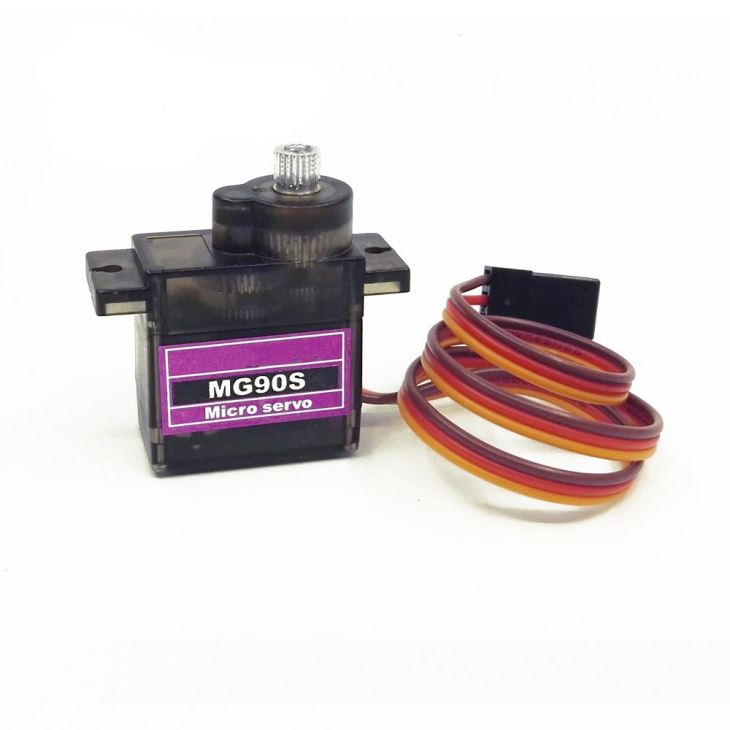
MG90S Micro Servo Motor
$ 2.77
This combination of small size and robust performance makes it the perfect choice for projects that require precision and strength in a small space. It’s ideal for robotic arms, steering in RC models (airplanes, cars, boats), and any project where you need a reliable and strong servo that can withstand more wear and tear. The MG90S is controlled by a standard 3-wire PWM signal, making it fully compatible with most microcontrollers, including all Arduino and ESP32/ESP8266 boards. Key Features Metal Gears: Provides superior durability, a longer lifespan, and less chance of stripping under load compared to plastic gears. Higher Torque: Delivers stronger stall torque than the SG90, allowing it to move heavier loads. Faster Speed: Operates at a quicker rotational speed, providing a more responsive feel. Standard 180° Operation: Rotates 90 degrees in each direction for a total of 180 degrees of movement. Universal Connector: The 3-pin connector is compatible with all standard RC receivers and microcontroller header pins. Technical Specifications Feature Specification Model MG90S Gears Metal Operating Voltage 4.8V – 6.0V Stall Torque 1.8 kg-cm (at 4.8V) / 2.2 kg-cm (at 6.0V) Operating Speed 0.10 sec/60° (at 4.8V) / 0.08 sec/60° (at 6.0V) Rotation Angle 180° Weight ~13.4 g Dimensions 22.8mm x 12.2mm x 28.5mm Pinout Controlling the servo is simple. Just connect the 3-pin header as follows: Brown Wire: Ground (GND) Red Wire: VCC (Positive Voltage, 4.8V – 6.0V) Orange Wire: PWM Signal (Data) Package Includes: 1x MG90S Micro Servo Motor 3x Servo Horns (Arms) Mounting Screws
Planting & Care
At a Glance – 3-in-1 Combination Peach Tree
- Sun: 1/2 day to full day of sun
- Soil: Well-drained, moderately fertile soil
- Water: Keep evenly moist during establishment
- Rootstock: Semi-dwarf (Lovell)
- Size: 12–15 ft at maturity
- Pollination: Self-fertile
- Harvest: July–September
- Hardiness: USDA Zone 5–9
Planting & Care – 3-in-1 Combination Peach Tree
Site Selection
- Choose a location with excellent sunlight to ensure full sweetness and color.
- Good airflow reduces fungal pressure, especially in humid or coastal climates.
Soil Preparation
- Prefers well-drained loam or sandy loam; avoid clay-heavy or waterlogged soil.
- Add compost to improve drainage and fertility.
- Ideal soil pH: 6.0–7.0.
Planting Instructions
- Plant at the same depth as in the nursery pot.
- Water deeply and mulch with 2–3 inches of organic matter.
- Keep mulch a few inches away from the trunk.
Watering & Fertilizing
- Maintain consistent moisture during the first 1–2 years.
- Deep water 1–2 times per week in heat or drought.
- Peaches are medium feeders—use a balanced organic fertilizer in early spring if growth appears weak.
- Avoid overfertilization, which reduces fruit quality and increases disease risk.
Pruning & Graft Management
- Prune more vigorously growing grafts to maintain balance across the tree.
- Encourage an open center to improve light penetration.
- Thin fruit clusters to improve size and prevent limb damage.
Harvest & Use
- Frost offers classic peach flavor with strong leaf curl resistance.
- Salish Summer (Q-1-8) produces juicy, richly flavored fruit well-suited to cooler climates.
- Indian Free provides brilliant red flesh and outstanding complexity.
- Muir delivers exceptionally sweet, aromatic fruit.
General Tips
- Combination peach trees thrive when graft vigor is balanced yearly through pruning.
- Renew mulch annually and water consistently for best fruit quality.
- Leaf curl–resistant varieties reduce the need for sprays in many climates.


